Nothing ruins a my day like the check engine light. Except for the FLASHING check engine light, which really means "STOP. NOW. Or you and your car might die".
Saturday morning I found myself at the repair shop with the Explorer. Cylinder 6 misfire. Bad coil? Bad plug? Maybe fried my computer? This can only happen on a holiday weekend, of course. And only when Baby Mama is borrowing the Lincoln.
Having reserved an intermediate rental car over the phone, the agency wanted to put me in a Nissan Sentra. In what parallel universe is a Sentra in any way "intermediate"? I asked what other cars were available and to my delight, they had a 2011 Buick Regal Turbo for $15 more.
This black on black rental didn't have a manual transmission. But seeing this as a three-day test drive, I didn't really care. I wanted to know how livable the Regal is beyond the hour we spent with it last December, when I test drove the 220 HP Turbo with three adults on board. Back then, I left thinking the more powerful (and more expensive) 270 HP GS would be the only Regal for us. Now, having driven the Turbo with fewer occupants, I'm in the unenviable position of being on the fence.
Both around town and on a run from northern Connecticut to New York City, I continue to be impressed at this car's quickness, agility, and desire to be driven fast and hard. It proved supremely comfortable and capable. I'm somewhere between proud and ashamed at the way I drove it to New York, tussling with a BMW 5-Series who was particularly pissed at being licked by a Buick.
When flogged, it doesn't come close to the EPA estimated 29 mpg. I don't think I hit 23. But the needle rarely dropped below 80 and spent a little time north of three digits, so go figure.
On one particularly cold 12° morning, however, the Buick was completely unwilling to lay down the power it had the day before. It wouldn't downshift properly in passing maneuvers and power off the line was limited. Later in the day, when the temp had risen another 10 degrees, the Regal seemed back to its old self.
With Anthony and I in the front, the car is really a three-seater, as legroom behind Anthony is severely compromised. When we did have additional passengers, the reports from the back seat were all good, with the exception of a certain bored 13-year-old.
We drove the Regal to the Volvo dealership when we test drove the S60 T5.
It gave us a nice chance to compare the two back-to-back. My initial
gut reaction was that the Volvo felt substantial, with deep power
resources and superior quality in build and materials. The Buick was
almost "new age solid". As if it were made from more modern, lightweight
materials, giving it a sort of aerospace rigidity. The weight and
safety systems of the Volvo are more confidence inspiring, but IIHS gives the two cars equal ratings. NHTSA hasn't weighed in yet.
A few minor quibbles:
- No seat memory - We love this feature in our current cars and really miss it on the Regal
- Awkward shape of side view mirrors
- Quirky iPod integration - Sometimes it worked, sometimes it didn't
- Center armrest doesn't accommodate front passenger beyond the elbow
- Piano black dash accents reflect blinding sun
- How can the GS not come with fog lamps when the Turbo does?
All in all, we thoroughly enjoyed our time with the Regal Turbo. Anthony is CONVINCED we need the GS with its Brembo brakes, perforated leather, multiple ride controls, and flat-bottomed steering wheel. But I'm not yet convinced we need it or its $2,500 premium over the Turbo. And, of course, we have to finagle similar experiences with the other vehicles that make the first cut.
If Regal becomes The One, we will have a happy few years of driving ahead of us.
Monday, January 16, 2012

Sunday, January 15, 2012
2012 Volvo S60 T5
After driving the S60 yesterday, this search officially got VERY difficult for me. And it was another successful conversion for Anthony, who was not so enthused about this brand... until he drove one.
I've owned a Volvo before (see sidebar), so to a certain extent, I've drunk the Kool Aid. This is a premium brand with exceptional design, ultimate safety, and engaging performance. And while parts of me hate to admit it, I like the idea of driving a premium brand and parking it in my driveway.

Upon entering the showroom, I spotted the exact color combo I would go for: Saville grey metallic with beechwood (think baseball glove) leather. No other brand in our search can match the beautiful aesthetic offerings of this brand. I love the design of this car, inside and out. It looks like it's moving when it's not, and the inside feels... furnished. It had the best fit and finish inside, clearly employing superior materials. The floating center panel of the dash flows into the console in one graceful movement. The placement of controls is intuitive, the graphic interface is simple and elegant, and the seats feel orthopedic in comfort.
Our salesman pulled up in a silver sample, and I was first to take the helm. Upon startup, the asynchronous purr of the turbo 5-cylinder is unmistakeably Volvo. While some might prefer not to hear or feel the engine at idle, there's something I really like about it. Even when laden with three grown men, the S60's 250 horsepower pulls the car with power to spare. The meaty steering wheel was well weighted and the car performed with commendable agility. In addition to traction and stability control, Volvo uses corner torque control - which gives greater power bias to the outside wheel when cornering to push the car in the desired direction, as opposed to both wheels fighting for the same pull under differing motion dynamics. The net result of this and the Volvo's twelve-dozen other safety features and systems is confidence. I felt like I could drive this car like an idiot and it would always take care of me — like a big hug from Dad.
I feel like I'm gushing. And I am.
There were a few shortcomings. The Volvo is small. I think our little family of tall people could get comfortable on a long road trip, but not nearly as comfortable as we'd get in the VW or Dodge. The next size up is the S80, which is a bit dowdy in design and I'm told is more sluggish on the road. We will probably drive one just to compare. Ticking options on the Volvo makes the price climb fast — though the base model is still very well equipped. And then there's maintenance. It's covered under the Volvo lease, but I still have nightmarish memories of the cost to maintain my old 850.
I want my family to be safe. I want classic design that endures. I want to have fun while I'm driving. For all of these reasons, we need to seriously consider the S60.
We are ready for eliminations in this search. I'm confident we will agree on the cars that won't make the first cut. But I'm concerned for our marital bliss when it comes to evaluating the finalists. To help us along, we will be returning to the dealerships for a deeper dive into the ones we like. I doubt I'll be able to keep myself from sniffing out an additional contender or two — but that's the fun of this. At least it is for me.
I have history with Volvo. I have a rare 1995 850 T-5r Estate — the first-ever R-series Volvo — that has been relegated to a project car (a car that sits in the driveway waiting for me to afford to restore it). If anything, our old T-5r is a testament to the renowned durability of this brand. She has 210,000+ on the odometer. And in all her hearse-like charm, she is fast as all get out.

Sunday, January 8, 2012
2012 Dodge Charger V-6 AWD
The embarrassing truth is that I'm not exactly sure which Charger we just drove. I didn't read the Monroney sticker and there are no less than eight flavors of the Charger on Dodge's site (pull it back, Dodge, that's ridiculous). When I called our salesperson, who was as knowledgeable about her product as I am about the relative viscosity of maple syrup, she told me it was a "Rallye". Yeah no. There's no Rallye in the 2012 lineup, according to Dodge.com. But I DO know it was a 2012 model with a V-6, AWD, and the new, 8-speed automatic transmission.

The car we drove was bright red with matching leather. So once we overcame the feeling of driving a hooker, we were free to enjoy our test drive.
It's aggressive. The Charger is a triumph in unabashed, American design that screams to other drivers, "Get the hell out of my way". That huge crosshair grille makes it look like a giant Prius-eating machine.
In an earlier post, I griped about the interior of the Charger. I'm just not a fan of the dash design. The focal point of the dash is a large, touchscreen, non-nav display that controls many vital functions. There are redundant analog climate controls beneath it. It has ample power ports, front and rear, and multiple ways to connect iPhone to the audio system. Blind-spot warnings and remote start were great features.
Pushing the start button triggered a pleasant exhaust note and idle purr. Shifting into reverse, the touchscreen was taken over by the backup camera image, with trajectory guides. We eased out into open traffic and experienced a smooth, quiet ride. The 292 horsepower provided solid, but not earth-shattering acceleration. While this car has the highest horsepower of any we've tested, I believe it's also the heaviest. Once at highway speed, the 8-speed transmission delivered nearly seamless downshifts and great access to passing power. At cruising speed, the car is quiet and smooth with flat, sure-footed cornering.
Most of all, what we like about the Charger is the size. It's a big car. We have no doubt that we would be comfortable on drives of any length. It drives much smaller than it is, however. Anthony noted how nimble it was when changing lanes in busy traffic. Both front seats were multi-adjustable, heated, and incredibly supportive and comfortable. Back seats were heated, too - a trait only the Optima shared. My size 11's did feel a bit crowded because of the transmission's foot well intrusion on the passenger side. And although it's a spacious interior, the wide a-pillar, short windshield, black headliner deco and high beltline make it feel a bit claustrophobic. Parking it on the streets of New York, might prove challenging.
Overall, I liked the Charger. But when I look at the high price of entry ($37,000+), I have issues. For a thousand more, we saw its platform-mate, the AWD Chrylser 300 on the lot - a car I like MUCH more in terms of aesthetics. Anthony is not in complete agreement with me on that point. Further, I liked the Buick SO much more than the Charger - and the Buick costs less. Still, the Buick Regal isn't available in AWD - and frankly we wouldn't consider the Charger (or 300) if it didn't have AWD.
We may return and drive a 300. But first, we have to get the Volvo on the road and see how it stacks up against the others. Once that's done, elimination begins!
Tuesday, December 6, 2011
Volkswagen Passat SE and SEL Premium V6
When we pulled into the VW dealer, Anthony had a face on. Not that much different than the time he tried that awful, trendy, sour frozen yogurt. But that's another story. He simply couldn't imagine us in a VW, even though I came within a heartbeat of buying one the last time we did this dance.
 I admire VW's new look. The Jetta was America's first introduction to the new style. Buttoned-down and conservative, it holds its head high even in base trim. The Passat follows that theme in the next size up.
VW has done a great job of using space wisely. Sitting in the back seat behind all 75" of Anthony, and even accounting for his more-than-slightly reclined driving position, I still had six or seven inches of space between my knees and his seatback. The Passat is huge inside.
We had a chance to drive two different trims, a 5-speed SE and an automatic SEL Premium V6.
At 170 hp, the SE was refined and capable, but not even close to exciting. German engineering always shines through, however, making the car feel really connected. Its solid feel and flat cornering impressed us. Controls are simple and logically placed and the cabin materials all had a quality look and feel, despite what I've read in the auto trades – and in contrast to the Kia. Shifting gears was a great experience - slickly and solidly pushing through the notches brought great joy even to Anthony's face.
Hopping into a black, top-line SEL Premium V6 gave us a more exhilarating experience. At 280 hp, it's more powerful than the Kia and Buick. Power was strong and readily available, especially when mashing the pedal on the highway. The SEL was much quieter than the SE - probably a result of added sound deadening materials. The cabin was far more upscale than the SE, featuring wood grain on the dash, footwell lighting (because it's important to see your shoes while driving at night), navigation, and a sound system tuned by Fender. Speaking of the nav, VW has a redundant display in the center of the gauge cluster that tells you what street you're on. Love. That.
After marinating a bit, I began to think that maybe this version is a little TOO conservative. The dash on the Passat is reminiscent of old (and current) Beetle dashes - a relatively flat expanse the width of the interior. This is in stark contrast to the wrap-around cockpits of the Buick and Kia. And the exterior is indeed the most elegant Passat to date, but it's almost yawn inspiring. I wished the wheels were bigger and that there were some additional contours to the bodywork.
VW has great hopes for their lineup. They currently sell about 250,000 vehicles a year in the U.S. By 2018, they want to up that number to 800,000. They plan on achieving their goal through aggressive pricing. The SE was about $24,000. The SEL was about $31,000. Seems they have their pricing right.
The Passat is a strong contender in our search. Especially since Anthony is now convinced that a VW could earn a place in our driveway - or at the drive-thru of our favorite oldskool frozen yogurt place.
Kia Optima SX GDI
It's hard for a lot of people to think of Kia as a real contender in the automotive world. But if you've been paying attention, Kia and its corporate sister, Hyundai, have the competition running scared.
I credit Peter Schreyer for much of Kia's success. Schreyer, who was on the design team for the Audi TT, A3, and A6, went to work for Kia in 2006. But it was only a few years ago when we started seeing the real fruits of his labor in the Kia line. Kia's entire lineup is now a family of beautifully designed, feature-rich vehicles with outstanding warranties. I couldn't wait to get an Optima SX on the road. And we just got that opportunity.
 Beside the beautiful exterior, Kia's value proposition is all about content for the dollar. There is a stunning amount of equipment in the SX. Dual sunroofs (coolest ever power sunshades moving in opposite directions from the center of the roof); ventilated front seats and heated seats for all four outboard occupants; navigation; power folding outside mirrors - it comes with a powerful 275 hp turbocharged four cylinder engine that returns 34 mpg highway. And all this for about $32,000. Yikes.
Sitting in the Kia, the cool factor hits you immediately. The all black interior was trimmed nicely with touches of carbon fiber (ish) and chrome. Controls are logically placed, though there is a dizzying array of buttons and knobs to control the infotainment and climate. A few fingernail taps around the cabin reveal some of the cost cutting measures Kia has taken. There is some cheap plastic here and there. For some reason, there is no carbon fiber surrounding nav panel, which is of course front and center on the dash. Instead, it's embedded in a sea of dead, textured black plastic. And the paddle shifters feel like model airplane parts. Still, so much is done right in this car that you find yourself constantly wondering if the cheap bits would really affect your ownership experience.
On the road the SX was pure smoothness. There is no adjustable ride control, so in comparison to the Buick Regal GS on "GS" setting, the ride is always suave and compliant, yet tight in cornering. The car feels long. Power was very good, though the four cylinder doesn't sound nice in the process. Even with three guys in the car, I was still able to stomp the gas and chirp the tires from a stop. Brakes were very good and brought us down from 60 mph quickly and smoothly.
I did some time in the front passenger seat which left me with concerns about taking long cruises in the Optima. First, the too-low, too-soft passenger seat is only 4-way adjustable. No up/down; no lumbar support. The arm rest on the door includes an angled panel on which the window control resides. The placement of this panel makes it impossible for me to rest my arm without a 45 degree vertical bend at the wrist. And the wheel hump intrudes far enough into the foot well that I felt I was having to sit slightly askew with my feet toward the console.
There really is a lot to love about this car. I'm still a sucker for the way it looks. The competition, however, is stiff - but is it stiff enough to beat the content and price? Don't know yet. There's still more driving to do.
I credit Peter Schreyer for much of Kia's success. Schreyer, who was on the design team for the Audi TT, A3, and A6, went to work for Kia in 2006. But it was only a few years ago when we started seeing the real fruits of his labor in the Kia line. Kia's entire lineup is now a family of beautifully designed, feature-rich vehicles with outstanding warranties. I couldn't wait to get an Optima SX on the road. And we just got that opportunity.

Sitting in the Kia, the cool factor hits you immediately. The all black interior was trimmed nicely with touches of carbon fiber (ish) and chrome. Controls are logically placed, though there is a dizzying array of buttons and knobs to control the infotainment and climate. A few fingernail taps around the cabin reveal some of the cost cutting measures Kia has taken. There is some cheap plastic here and there. For some reason, there is no carbon fiber surrounding nav panel, which is of course front and center on the dash. Instead, it's embedded in a sea of dead, textured black plastic. And the paddle shifters feel like model airplane parts. Still, so much is done right in this car that you find yourself constantly wondering if the cheap bits would really affect your ownership experience.
On the road the SX was pure smoothness. There is no adjustable ride control, so in comparison to the Buick Regal GS on "GS" setting, the ride is always suave and compliant, yet tight in cornering. The car feels long. Power was very good, though the four cylinder doesn't sound nice in the process. Even with three guys in the car, I was still able to stomp the gas and chirp the tires from a stop. Brakes were very good and brought us down from 60 mph quickly and smoothly.
I did some time in the front passenger seat which left me with concerns about taking long cruises in the Optima. First, the too-low, too-soft passenger seat is only 4-way adjustable. No up/down; no lumbar support. The arm rest on the door includes an angled panel on which the window control resides. The placement of this panel makes it impossible for me to rest my arm without a 45 degree vertical bend at the wrist. And the wheel hump intrudes far enough into the foot well that I felt I was having to sit slightly askew with my feet toward the console.
There really is a lot to love about this car. I'm still a sucker for the way it looks. The competition, however, is stiff - but is it stiff enough to beat the content and price? Don't know yet. There's still more driving to do.
Saturday, December 3, 2011
Buick Regal Turbo and GS
Dad's 1976 Buick Electra Limited was a thing of beauty. Twenty feet of Independence Red paint and glinty chrome; black leather inside with engraved faux-wood inlays in the doors. It floated, silently, above the road. My, how things have changed.
I've been watching GM for years and am in love with the direction they're taking. Buick is aiming to be the luxury/performance division of GM, targeting Lexus as a prime competitor. Their efforts are working and the demographic of their buyers is dropping.
 The new Regal is nothing like the last one, which was a Chevy Impala sister-ship. This one started as an Opel Insignia, in Europe, and it looks and performs like no other Buick you've experienced.
What we (Anthony in particular) likes most about the Buick is that it's available in a manual transmission - very rare for this class of car. And a welcome feature!
We spotted two examples, a Turbo and a GS and decided to drive both in order to solidify our focus on one vehicle.
We drove the 220 hp Turbo, first. It was a 2011 - black on black - well equipped but lacking a few things we'd like, like touchscreen navigation and push-button start.
The fit and finish was first rate. And the interior gives the driver and front passenger a real "cockpit" feel. The cowl wraps around the occupants. Outward visibility is good (not great). I prefer a little wood on the dash, rather than the aluminum and piano black accents the Regal has. But it works. It conveys a sporting feeling. The interior is more intimate than we thought we wanted, but it's not uncomfortably tight and rear seat legroom is acceptable, even with a 6' 2" driver.
Saddled with about 500 lbs of passengers (the two of us and a 6' 2" salesman), power from the turbo four cylinder was sufficient, but not at all enthralling. Fuel economy at 32 highway is good. Shifting is smooth and linear. Clutch engagement was just right.
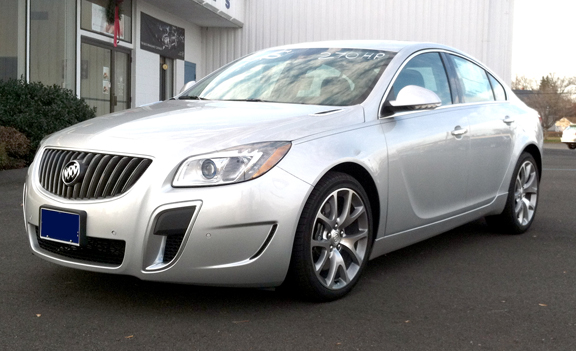
Switching to a silver GS, the first thing you notice is more aggressive styling. Beautiful open-spoke rims revealing Brembo calipers on giant discs. A unique front fascia with aggressive vertical air intakes. It continues in the interior with heavily bolstered seats, perforated leather, and a flat-bottomed steering wheel.
The GS's added 50 hp was evident the moment we pulled out of the driveway. The car WANTS to go 80 and provides a nice push of thrust at each row of the 6-speed. I am really looking forward to driving this car alone, without the weight of other passengers. The drivetrain has multiple modes, including GS, which tightens steering and suspension and provided the most fun weaving in and out of 4 lanes of highway traffic.
The car would benefit from a panoramic glass roof. And our salesperson expressed concerns about iPhone connectivity, but Buick's website claims it's easy. We were surprised not to see fog lamps, ventilated front seats, and heated rear seats. These might be available as options. American manufacturers still haven't caught on to the fact that fewer options packages are better, and the top of the line model should have EVERYTHING.
GM set the bar high in our search. We adored the GS - it will be our choice if we decide on Buick. I can't wait to see how the competition stacks up.
I've been watching GM for years and am in love with the direction they're taking. Buick is aiming to be the luxury/performance division of GM, targeting Lexus as a prime competitor. Their efforts are working and the demographic of their buyers is dropping.
What we (Anthony in particular) likes most about the Buick is that it's available in a manual transmission - very rare for this class of car. And a welcome feature!
We spotted two examples, a Turbo and a GS and decided to drive both in order to solidify our focus on one vehicle.
We drove the 220 hp Turbo, first. It was a 2011 - black on black - well equipped but lacking a few things we'd like, like touchscreen navigation and push-button start.
The fit and finish was first rate. And the interior gives the driver and front passenger a real "cockpit" feel. The cowl wraps around the occupants. Outward visibility is good (not great). I prefer a little wood on the dash, rather than the aluminum and piano black accents the Regal has. But it works. It conveys a sporting feeling. The interior is more intimate than we thought we wanted, but it's not uncomfortably tight and rear seat legroom is acceptable, even with a 6' 2" driver.
Saddled with about 500 lbs of passengers (the two of us and a 6' 2" salesman), power from the turbo four cylinder was sufficient, but not at all enthralling. Fuel economy at 32 highway is good. Shifting is smooth and linear. Clutch engagement was just right.
Switching to a silver GS, the first thing you notice is more aggressive styling. Beautiful open-spoke rims revealing Brembo calipers on giant discs. A unique front fascia with aggressive vertical air intakes. It continues in the interior with heavily bolstered seats, perforated leather, and a flat-bottomed steering wheel.
The GS's added 50 hp was evident the moment we pulled out of the driveway. The car WANTS to go 80 and provides a nice push of thrust at each row of the 6-speed. I am really looking forward to driving this car alone, without the weight of other passengers. The drivetrain has multiple modes, including GS, which tightens steering and suspension and provided the most fun weaving in and out of 4 lanes of highway traffic.
The car would benefit from a panoramic glass roof. And our salesperson expressed concerns about iPhone connectivity, but Buick's website claims it's easy. We were surprised not to see fog lamps, ventilated front seats, and heated rear seats. These might be available as options. American manufacturers still haven't caught on to the fact that fewer options packages are better, and the top of the line model should have EVERYTHING.
GM set the bar high in our search. We adored the GS - it will be our choice if we decide on Buick. I can't wait to see how the competition stacks up.
Friday, December 2, 2011
The Short List
Auto shows are great places in which to kick a lot of tires and meet knowledge experts from the whole spectrum of brands, without any sales pressure. I attend the New York International Auto Show every year, and this year scored a VIP tour before the show opened to the public. This gave me my first glimpse into the candidates for my next purchase.
A few weeks ago, I brought my family to a smaller show, near our "country" home, to get their feedback on the vehicles on the short list.
Here's what we like, in no particular order:
Let the test drives begin!
A few weeks ago, I brought my family to a smaller show, near our "country" home, to get their feedback on the vehicles on the short list.
Here's what we like, in no particular order:
2012 Kia Optima SX GDI
I've been watching Kia since Audi designer, Peter Schreyer, joined the firm as design lead. His influence is groundbreaking. Different from Hyundai's trendy, polarizing Korean aesthetic, Schreyer has given Kia a more European flavor that I believe will endure. Combine that with the astonishing level of content for the price and a lengthy warranty, and it seems hard to go wrong. The Optima is gorgeous. In SX trim it packs 275 horsepower but serves up 34 mpg (highway). It can be had with navigation, panoramic glass roof, and heated seats for all four outboard positions for about $31,000.
2012 Buick Regal GS
My Dad was a Buick guy. But his was a whole different kind of Buick. This brand has undergone a metamorphosis from floaty, couches-on-wheels for the 70+ crowd to driver-centric cars with flowing designs and beautiful interiors. The Regal GS is an Americanization of the European Opel Insignia. It has a 270 horsepower turbo four cylinder in a taut package that fits like a glove. Careful selection of options puts it in the right price point for our purposes.
2012 Volkswagen Passat
Volkswagen's new design language is all about conservative elegance. The new Passat is (visually) the understated big brother of the new Jetta. Its clean lines and massive rear leg room stood out to me. While I'm reluctant to by any car, especially a VW, in its first year of production, my experiences with the previous model leave me wanting to give it a try.
2012 Dodge Charger AWD
When I first saw the 2012 Charger at the NY show, it took me five minutes to take it all in. It's a seriously badass car. To some, it might seem a waste to forgo the Hemi - as it looks like it's BEGGING to be driven fast. But we're interested in the V-6 with all-wheel-drive. The interior is the Charger's shortcoming. The dash is uninspired. But we'll reserve judgment until we drive one.
2012 Volvo S60 T5
This one is pushing the price point. But Volvo has done an excellent job at implementing its new, flowing design language into a beautifully sculpted sedan with gorgeous interior treatments. Volvo leases include basic maintenance and the warranty covers wear and tear. From past experience, however, I'd never own another Volvo that's out-of-warranty. Price for entry in the repair shop for the last Volvo I owned rarely dropped below four digits.Let the test drives begin!
Subscribe to:
Posts (Atom)